

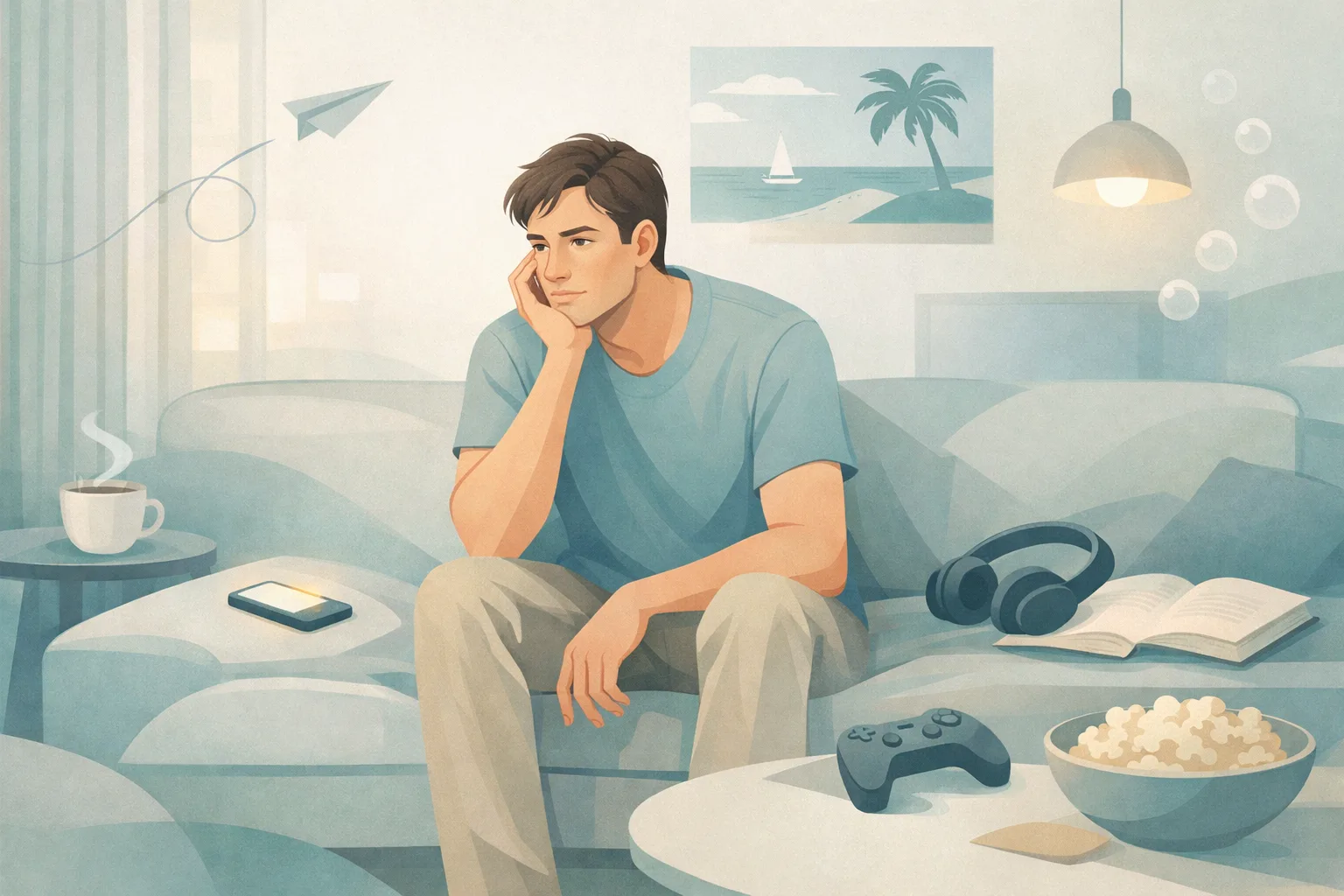
Boredom does not feel neutral when you are inside it
People often talk about boredom as if it were a mild inconvenience, but lived boredom can feel much more agitating than that. It can feel restless, empty, trapped, lonely, irritated, or vaguely hungry for something. That inner state creates pressure, and habits often rush in to solve it.
This matters because many compulsive patterns are not driven by intense pain alone. They are also driven by the discomfort of flatness. If nothing feels engaging, meaningful, or alive enough, the brain starts scanning for novelty and frictionless stimulation.
Why boring moments create so many openings for bad habits
Boredom lowers the threshold for shortcuts. When attention is underfed, almost any fast reward starts looking more attractive: scrolling, snacking, shopping, checking messages, sexual stimulation, gossip, or pointless detours that break momentum. The habit does not have to be deeply satisfying. It only has to be more stimulating than the moment you are in.
That is why boredom is such an underestimated trigger. It does not always announce itself with a dramatic emotion. It often appears as “I will just check this for a second” or “I need something.” But underneath that small move is usually a nervous system looking for sensation, relief, or momentum.
- Boredom makes novelty feel urgent
- Fast rewards start looking more reasonable than long-term goals
- Low-stimulation moments often create the highest temptation windows
Not all boredom is the same
Some boredom comes from understimulation. Some comes from disconnection. Some comes from avoiding a harder task and hovering in an in-between state. These versions feel similar on the surface, but they are not solved in the same way.
If the boredom is really loneliness, distraction will not help for long. If it is mental fatigue, forcing more input may make it worse. If it is task avoidance, then the problem may be anxiety disguised as boredom. The more precisely you name the state, the easier it becomes to interrupt the habit loop instead of feeding it blindly.
The goal is not a perfectly exciting life
No one can build a life where every hour feels vivid and meaningful. The real skill is learning how to survive low-stimulation moments without immediately outsourcing them to habits that leave you feeling worse. That often means preparing better alternatives in advance: movement, frictionless low-effort tasks, a short walk, a call, a notebook, a defined pause, or a more honest break.
Once boredom is named as a trigger instead of a personality defect, the situation becomes more workable. You stop asking “Why am I like this?” and start asking “What kind of boredom is this, and what am I actually reaching for?” That question alone can create a lot of room to choose differently.